
A recent paper in Philosophy Now explores the issue of AI as an ethical agent. James Moor define four kinds of ethical robots:
- Ethical impact robots, where the actions of the AI may have intended or unintended ethical consequences. For example, an AI that encourages someone to commit suicide or a driverless car that doesn’t recognise a horse and rider.
- Implicit ethical agents have ethical considerations built into their design – for example, ATM cash machines have built in safeguards to protect users from fraud. If infected by a malicious virus, however, these agents may become unethical.
- Explicit ethical agents attempt to make judgements in complex situations, following an if-then logic. The limitation arises when it encounters new situations. Theoretically the AI can learn and adapt, but only after flawed ethical decision-making is revealed. It needs an external agent (a human) to identify such situations. A core problem is that, the more complex an ethical issue becomes, the more important ethical values become and the greater the influence of context in determining which values apply and which take precedence.
- Human beings are full ethical agents – they have consciousness, intentionality and free will. They “make ethical judgements about a wide variety of situations (and in many cases can provide some justification for the judgements”).
Although AI is developing fast, it is a long way from being able to replicate being a full ethical agent. However, says Moor, in certain situations, good enough judgements may be all that is needed – for example, in search and rescue robots.
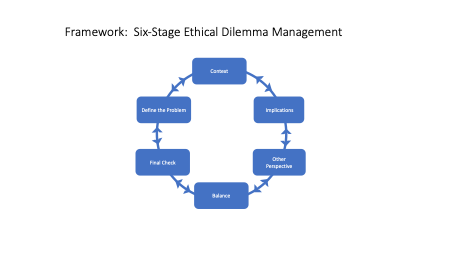
The immediate opportunity for AI in ethical mentoring and coaching is in supporting coaches, mentors, supervisors and clients in thinking ethical issues through in a structured way, such as in the diagram below, which comes from CCMI ethical mentor training. The key here is that AI is not making any judgements or decisions; it is making sure that the decision-maker is able to test and justify their reasoning, making sure that they have taken into account as many as possible of the complex issues involved. The AI support can be multi-layered. Where the decision-maker is unsure, the level of questioning can go deeper. For example, in defining the values that should be applied to a situation, if the decision-maker is unsure, the AI can present other dilemmas that help through analogy.
There’s also a role for coaches and mentors to point out where implicit AI agents are resulting in unethical decisions. For example, recruitment AIs often contain algorithms that are unintentionally discriminatory.
So, as with so much of AI, the solution is to welcome it as a thinking partner, but not to hand over the power of decision-making.
©️David Clutterbuck, 2026