
Raising culturally-derived awareness and building culturally-appropriate responsibility
Using the Cross-Cultural Kaleidoscope
Abstract
Whitmore (2002) defined the essence of good coaching practice as “building awareness and taking responsibility.” A phenomenological approach to a research study conducted as part of an MA in Coaching and Mentoring Practice (Name author, 2009) built on the Whitmore definition through an exploration of the possibility that the coach can facilitate the understanding of cultural worldviews in the coaching relationship. It identified that raising culturally-derived awareness and the building of culturally-appropriate responsibility were key to intercultural coaching practice. The Cross-Cultural Kaleidoscope™ is a tool designed to make sense of the complexity of the intercultural domain in which Global Executive Coaches or Cross-Cultural Coaches operate. It was subsequently further researched for its applicability in cross-cultural research practice.
This paper examines knowledge from cultural theorists, psychology, global leadership, systems and values theories which informed the model. A systems approach to coaching (Cavenagh, 2006) was found to best accommodate both the internally-held meaning of culture, described as the cultural self and the external factors such as the historical or political landscape that continue to influence thoughts, emotions habits and behaviours (Plaister-Ten, 2009). Furthermore, it was found that values are the “brokerage” unit between the internal and external worlds (Hall, 1994).
Reflective feedback was gathered about the experiences of coaches practicing cross-culturally when using the Kaleidoscope in practice. Amongst the conclusions is the need to be cognizant of dangers of transporting ‘Western’ models of coaching when operating interculturally. There is a warning of the dangers of sophisticated stereotyping (Osland et al 2000) and an illumination of the potential to work with the ‘unlearning’ of those cultural values and beliefs that are no longer appropriate for the coachee; given a change of context (Plaister-Ten, 2010). In addition to its value in identifying culturally-derived awareness and culturally-appropriate responsibility, the Kaleidoscope has been said to deepen the coaching relationship. It also has the problem-solving and transformative properties that global organisations working in a virtual global team environments demand as globalisation intensifies.
Keywords: The Cross-Cultural Kaleidoscope™, Cross-cultural Coaching, Global Executive Coaching, Global teams, Culturally-derived awareness, Culturally-appropriate responsibility
Introduction
Cross-Cultural Coaching takes place amongst and within multi-cultural societies, workplaces and teams. Technological advances thanks to the internet and mobile solutions make it easier to both collaborate and compete across borders in virtual teams, whilst air travel demand is forecast to increase to 3.6bn in 2016, which is a 28% increase over 2011 (IATA, 2012). Migration persists with more people now living outside their home countries than ever before. According to the United Nations Population Fund (2011), 214 million people, out of a total population of 7 billion, are living outside of their country of birth. A further 700 million move around inside their home countries. This contributes to Creolised societies and workplaces (Hannerz, 1992).
As far back as 1992 (Schein, 1992) stated “cultural understanding is desirable for all of us but it is essential for leaders if they are to lead.” Leaders today must be globally minded; capable of developing competencies within a changing, highly complex world. This calls for the creation of more flexible, adaptable and creative teams that are culturally diverse and globally mobile (Pricewaterhouse Cooper, 2010).
Moran et al (2007, p.10) assert, “Culture is a complex system of interrelated parts that must be understood holistically.” Global Executive Coaching is essentially a conversation with a leader that takes place within the complexity of a multi-national corporation; a complex adaptive system (CAS) (Holland, 2006). The coaching relationship, when incorporating culture into the mix, may therefore be seen as a “complex adaptive system,” (Cavanagh, 2006, p. 315). This macro approach to coaching takes historic, economic, political, social, environmental and educational factors into account as well as the micro approach relating to the individual in the context of his immediate relationships. Global Executive Coaches can facilitate this by asking the incisive questions necessary to identify not only cross-cultural but cross-functional patterns and to cut through the intricacies.
Operating globally, not to mention virtually, demands an understanding that there are culturally-bound approaches to time, authority, communication styles, autonomy, respect for processes, adherence to rules, the importance of relationship-building, allegiance to individual or collective goals, to name but a few. However, differing work practices get confused with cultural values and beliefs (Hofstede, 2003). Differing work practices mean just that. It is the values and value systems: (Inkeles and Levinson, 1963), (Rokeach, 1973), (Schwartz, 1995), (Ingelhart, et al 1998), (Bond et al 2004) that drive them that is the point of enquiry at which intercultural consultants, coaches and trainers can have impact. However, there is still relatively little understanding pertaining to the internalisation of culture and the meanings attributed by individuals to cultural values and beliefs (Gilbert and Rosinski, 2008).
Effective Global Executives operate within a dynamic environment: multicultural (individual, corporate and national); the generation and sustenance of international business opportunities; and leadership in the face of such complexities. An understanding of the context in which leaders are operating, along with cultural values at multiple levels of enquiry, must surely assist with this navigation. It is suggested therefore that it is incumbent on the coach to be able to ‘hold the space’ for the intricacies facing global leaders and their teams. The ability to raise awareness to global external factors that influence values, perceptions and drive decisions is, or must shortly become, a core competency for the Global Executive Coach. The Cross-Cultural Kaleidoscope™ is a tool that is offered to assist with this.
The Cross-Cultural Kaleidoscope™ model is informed by theory from the fields of intercultural studies, cultural anthropology and cross-cultural psychology along with global management and leadership theory. At the time of the original research study in 2008, there was little theory in intercultural coaching and practice to draw on with the exception of Rosinski, (2003). Rosinski’s Cultural Orientations Framework (COF) at the time was said, by the research participants, not to be widely used in practice. Since 2008, Law et al (2011), Moral and Abbot (2009), Stout Rostron (2009), the Association for Coaching and Passmore (2009) and Shams and Lane (2011) have posited a cultural perspective in coaching.
Values and value systems theory
An examination of values is often a good place to start in coaching. For this reason it is possible to emerge as good practice for Global Executive Coaches to familiarise themselves with the theory encompassing cultural values.
During the 1960’s, psychologists such as (Rogers, 1964) identified “operative” (action-oriented preferences) and “conceived” (assimilated from others) values in the context of value systems. He did not however appear to consider the impact of culture. Rokeach (1973, p.7) was amongst the first cross-cultural study of values and value systems (US, Canada, Australia and Israel), classifying “terminal” (goals and aspirations) and “instrumental” (moral and competence) values. Rokeach (1973, p.326) found that “culture, society, and personality are the major antecedents of values and that attitudes and behaviour are their major consequence.”
Schwartz (1995) Value Survey (SVS) identified 56 values and by 1995 had surveyed 25,000 people in 40 countries. Seven cultural value orientations and ten individual motivational value types were identified, in addition to two universal dimensions organising value systems: ‘openness to change/conservation’ and ‘self-transcendence/self-enhancement’. Differing from previous examinations of values, the study separated individual and cultural values for the first time, thereby rendering it ‘ecologically sound’.
The World Values Survey (Ingelhart et al 1998) measured attitudes, values and beliefs concerning politics, economics, religion, sexual behaviour, gender roles, family values and ecological concerns from 40 societies, representing 70% of the population. Two dimensions were identified in 1997: ‘traditional/secular-rational’ and ‘survival/well-being’. Focused on the effects of cultural change, Ingelhart suggested that survival values shift towards self-expression values as societies develop economically and identified new values including self-descriptions of tolerance, respect for diversity and the environment and interpersonal trust.
According to Bond et al (2004, p.553), “social axioms are generalised beliefs about oneself, the social and physical environment, or the spiritual world.” Social axioms incorporate individual responses within cultures and are an assertion about the association between two entities. The research found two new dimensions: ‘dynamic externality’ and ‘societal cynicism’; reflecting survival instincts in societies characterised by poverty in the former and the disruptive effects of social, political and economic change in the latter (Van de Vjifer et al, 2008).
Despite the enormous contribution to intercultural theory, these studies based on values and values systems have had seemingly relatively little impact in the workplace. Yet, as Hofstede (2001, p.10) suggests “systems of values are a core element of culture.”
Cultural dimensions
The studies of culture that continue to have influence in the workplace involved large scale quantitative studies that have resulted in categorisations of cultural norms; generally known as cultural dimensions. They typically do not address the meaning that an individual ascribes to membership of a particular culture. Most large-scale research programmes inform the coach of the tendencies of groups of people. Whilst personal values may be said to be unique, those held collectively produce a “habitus, a system of permanent and transferable tendencies,” according to Hofstede (2001, p.4).
Kluckhohn and Strodtbeck (1961) were among the first anthropologists to define universal dimensions of culture. In addition to human-nature they classified differences in relation to nature, human relationships, activity and time. Inkeles and Levinson (1963) adopted a systems approach to the integration of the personality and the socio-cultural environment. They looked for universal characteristics of a mature person along with common socio-cultural characteristics of societies and identified the following: ‘relation to authority’, ‘conception of self’ and ‘common conflicts and their resolution’.
The work of Hofstede (2001, 2003) is perhaps still the most referenced. By means of a cross-cultural quantitative survey, he measured work-related value differences between IBM subsidiaries in 40 countries in 1980. He initially identified four cultural dimensions measuring the intensity and direction of values on a linear axis: ‘power-distance’; ‘uncertainty-avoidance’; ‘individualism/ collectivism’ and ‘masculinity/femininity’.
Knowledge of cultural dimensions may inform the coaching relationship. It can be useful to understand the culturally-bound responses of national groups, such as the tendency of Asians to avoid saying ‘no’, the German adherence to strict time-keeping, or the Spanish need to socialise before business, to quote just some examples.
Of all the Hofstede dimensions, the most widely understood is individualism/collectivism. Hofstede (2001, p.211) suggests that “it is closely linked to a country’s level of economic development,” therefore nations may exhibit greater individualism as they modernise. Triandis (2001) expresses this as being open to new experiences, independent and feeling in control. Coaching, having emerged from an individualistic culture; the USA, has a tendency towards goal and performance-oriented coaching processes in the workplace, perhaps originating from management by objectives (MBO’s), (Drucker, 1954). This may not be applicable in cultures placing greater value on the success or well-being of the group, such as China. Furthermore, as the social behaviours, thought patterns and communication styles between individualistic and collectivist cultures (Fisher, 1998) differ greatly, this potentially causes misunderstandings that could be presented as issues in the coaching engagement.
The masculine/feminine dimension has been largely overlooked by North American researchers because “it is considered politically incorrect,” according to Hofstede (2006, p.894). This dimension explores the emotional and social roles of the genders. Cultures which are feminine in orientation; such as Sweden, Norway and the Netherlands, put more emphasis on relationships, environment, co-operation and benevolence. A masculine society on the other hand; such as Japan and several of the South American and Northern European countries, put more emphasis on competition, achievement and achievement. These tendencies are likely to be reflected in the approaches an Executive may have to decision-making and to team-work.
The importance of power-distance may impact the degree of non-directional influence the coach is able to exercise when deference to authority is prevalent in a society demonstrating a high power distance indicator (PDI), such as China. It will also reveal the extent to which employees will demonstrate autonomy or refrain from taking responsibility. A low PDI score will indicate an egalitarian approach to decision-making where it is expected that authority should be challenged or at least questioned by subordinates.
The uncertainty-avoidance dimension helps with an understanding of the cultural values associated with attitudes to difference with those scoring high on the Uncertainty Avoidance Indicator (UAI) viewing difference as dangerous and those scoring low viewing it as curious. Those with a high UAI such as Belgium or France could exhibit anxiety-related behaviour such as prejudice, traditionalism, superstition and an intolerance of ambiguity. They may therefore expect others to adhere to the rules upholding these traditions. In business this could translate into dictatorial leadership styles and an over reliance on contractual terms and conditions. Low UAI societies feel more able to influence their own lives and those of their superiors or authorities. They may be more able to cope with ambiguity, less reliant on the written contract and may be more willing to take risks. Coaching could serve as a gateway to the exploration of emotions behind these values and the impact upon co-workers.
Bond (1983) later conducted the Chinese Value Survey that culminated in a fifth dimension: ‘long-term versus short-term orientation’. A long-term orientation is focused towards future rewards whereas the short-term orientation is related to the immediate past or the instant gratification of the present. This dimension incorporated questions that reflected values such as filial piety, respect for tradition, unequal status in relationships, shame, thrift and mindset previously unattended to in the original Hofstede studies. This is extremely useful to those coaching people from ‘the East’.
A sixth dimension, ‘indulgence vs. self-restraint’ was added (Hofstede et al, 2010) reflecting a society that puts little restraint upon the human need to enjoy life and have fun, compared with one that suppresses such a need and has developed social norms to restrict it. For example, the optimism of people from the USA, the emphasis upon a social life in the UK may compare sharply with viewing smiling as suspect in Russia or a lack of freedom of speech in communist China.
Others who have greatly contributed to the theory of cultural dimensions include Trompenaars and Hampden-Turner (1997). Following 15 years of research they identified seven cultural dimensions concerning relationships to nature (inner/outer directedness) and time (sequential/ synchronic), involvement (diffuse/specific) and emotional expression (affective/neutral). They criticise Hofstede’s linear approach, explaining that cultures “dance” in circles and generate new meanings from otherwise opposing values.
This distinction is important and is perhaps the reason for a departure, at least amongst interculturalists, from looking at culture from an ‘either/or’ paradigm. As we engage more now with people from ‘the East’, we can perhaps see the value in taking a ‘both/and’ perspective, as depicted by the Ying and Yang symbol. Looking for the best of both worlds should come relatively naturally to coaches coaching from a positive enquiry perspective. Yet, holding the complexity of sometimes opposing values and the paradox of ‘both/and’ positions may require some advanced skills and a willingness to consider the complexity within which the Executive operates. A Complex Adaptive System (CAS) (Holland, 2006) has multiple ‘agents’ or networks, interacts, learns, changes and adapts to its environment creating new boundaries and innovation. According to Holland, adaptation to a CAS is key for leaders. These captains of industry need to find ‘lever points’ or key areas of influence in the corporate system. Once found, a coach can be instrumental in facilitating a leadership approach to complexity that seeks to build upon established techniques and to develop new ways of doing things.
Global Leadership
The Global Leadership and Organizational Behavior Effectiveness (GLOBE) study (House et al, 2004) is a research study focused on culture and leadership in 61 nations. The study took place over several years and identified 6 global leadership dimensions of: Charismatic/Value-Based, Team-Oriented, Participative, Humane-Oriented, and Autonomous, Self-protective.
The questionnaire built on the original work of Hofstede (2001), Kluckholm and Strodtbeck (1961), McClelland (1985) and Putnam (1993) and explored differences and similarities in global leadership. It found five leadership dimensions that were universally accepted including: integrity; being inspirational; results-orientation; being visionary and team orientation. Two dimensions were universally not accepted including: being unethical; self-protectionism or advancement. There were six that were found to be culturally contingent and included: status consciousness; a procedural orientation; being autonomous; humane orientation; taking risks for greater good; and competitiveness.
This study has illuminated the fact that leadership is undoubtedly a universal phenomenon; but the value that different cultures place on different aspects varies widely. This has been termed Implicit Leadership Theory (ILT) (House et al 2002).
ILT can account for differing leadership styles amongst national cultures and the mis-matched expectations that very often cause mis-understandings. The study therefore concluded that acceptable management practices in one country are not guaranteed to work in another. Moreover, and perhaps even more significantly, the study has identified that there are not only differences, but similarities. A skilful coach working with a diverse team can leverage these synergies for increased effectiveness, harmony and competitive advantage.
Impact upon the coaching profession
Knowledge of cultural theory provides valuable insight to the coach, but it does not provide the whole picture. It can lead to a tendency to evaluate dimensions on an either/or basis whereas in reality a person is often a complex mix; exhibiting different traits in different circumstances. Gannon (2001) concurs, suggesting that the psychological impact of culture has been overlooked. The UK for example, has a lower degree of emotional expressiveness (‘stiff upper lip’) than the United States, although they score similarly on (Hofstede 2001, 2003) individualism dimension.
Furthermore, knowledge of intercultural theories, in particular dimensions (Hofstede, 2003, Trompenaars and Hampden-Turner, 1997) can lead to what has become known as sophisticated stereotyping (Osland and Bird, 2000). It can therefore be useful to the intercultural coach to form a hypothesis in the coaching relationship about what values their coachee/s might have. Nevertheless, it is equally as important to bracket this awareness and to hold different cultural values lightly in order to avoid making assumptions and projections.
Identifying cultural norms, values and beliefs and the impact of the social environment reflects a social constructivist approach, originally postulated by Vygotsky (1962). This approach is generally concerned with the emergent nature of meaning-making. This can represent a paradox for leaders who often need to demonstrate firm values and swift decisions; yet are operating in an environment that is unpredictable and constantly changing. Moreover, a person’s values can also be restrictive, potentially being the source of limiting core beliefs, (Ellis & Harper, 1997). These can be expressed as culturally-mandated imperatives such as “shoulds” and “oughts.” Trilling (1955, p.xiv) draws a comparison of culture expressed as customs to a prison, suggesting that it “lies like a weight” upon the prison house. Hall (1959, p.182) argues “it (culture) is in fact a prison unless one knows that there is a key to unlock it.” Furthermore, Hofstede (2001, p.18) explains that identifying culture-related behaviour is difficult. He states, “it takes a prolonged stay abroad and mixing with other nationals there for us to recognise the numerous and often subtle differences in the ways they and we behave, because that is how our society has programmed us.” This is because our cultural values and beliefs are held sub-consciously and it is therefore incumbent on the Cross-Cultural Coach to surface them. According to Hall (1959, p.29) “culture hides more than it reveals and what it hides, it hides most effectively from its own participants.” This acknowledgement can provide the coach with fertile ground for exploration.
Taking account of the impact of culture in the coaching relationship therefore means an exploration of culturally-derived awareness and building of culturally-appropriate responsibility. These distinctions are important. Firstly, culturally-derived awareness takes account of the intercultural differences that may be impacting the coaching issue; such as misunderstandings between team members from different countries. Key to this is use of the word may. It would clearly be inappropriate to project any intercultural knowledge into the coaching mix and to seek to identify intercultural issues. As with any coaching engagement, the coachee leads the way.
Clearly, the more the cross-cultural coach is informed with knowledge about cultural norms, then the easier it is to navigate the intercultural landscape. Building culturally-appropriate responsibility on the other hand, requires a keen understanding of the fact that not all cultures have the same choices. Those that are guided by religious beliefs for example, may not exhibit the same level of autonomy that is derived from personal choice. This will undoubtedly affect the ‘options generation’ part of the coaching process. Not only that, responsibility means different things to different people. According to Fisher (1998, p. 63), “differing values lead to differing definitions of success.” The Chinese value of harmonious relations for example, reflects the importance of self-control contributing to the success of the group. Hofstede, (2010) further advises that different values lead to differing priorities placed upon business goals, with the Chinese for example, typically placing more importance upon the responsibility to society than the short-term profits.
Whitmore (2002, p.32) states, “building awareness and responsibility is the essence of good coaching.” Working with awareness in the coaching relationship seems to be the crossroads where psychology and culture meet. Hofstede (2003, p.230) asserts, “awareness is where it all starts.” From awareness cultural meanings may be explored. It is therefore a key proposition in this article that that “raising culturally-bound awareness and building culturally-appropriate responsibility” is the essence of good intercultural coaching.
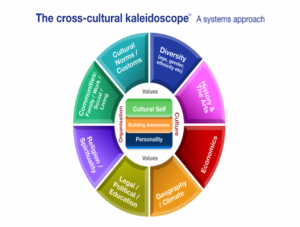
Introduction to the Cross-Cultural Kaleidoscope™ Model
The Cross-Cultural Kaleidoscope™ model emerged from a phenomenological research study “Toward Greater Cultural Understanding in Coaching” as part of an M.A. in Coaching and Mentoring Practice (Name author, 2009). It grew from the stories that the research participants were sharing about their experiences of coaching in a multi-cultural context. The sample consisted of highly experienced professional coaches; practising in 27 countries who had collectively coached 43 different nationalities and represented more than 20,000 coaching hours across all the continents of the world. It has been subsequently tested further, with a sample of 10 intercultural coaches for its applicability as a coaching tool.
A systems approach is represented through the lenses of the Kaleidoscope model. The ‘external’ lenses suggest a ‘window’ through which an issue may be examined and which in turn have a bearing on the thoughts, feelings and decisions that drive behaviour. There is however, an invitation to hold this image ‘loosely’ as the coach works with the model. The model serves primarily as a guide and as an awareness-building tool. To draw sweeping conclusions may further perpetuate stereotyping; one of the social ills of our time.
The imagery of a Kaleidoscope placed the global leader and consequently his coach, in an environment that is dynamic; with multiple influences interweaving and interchanging from the external environment; providing the context. Yet, it was the internal cultural self that makes meaning of all these influences.
The ‘internal’ influences of culture are largely expressed as a form of self-identity and represented by the ‘cultural self’ (or selves). As such, the inner part of the kaleidoscope represents the thoughts, feelings and emotions held by an individual about their own cultural identity. The experiences throughout their lifespan contribute to a shift in this identity; or indeed a need to shift brought about by a change in context such as an expatriate posting, repatriation or merger with a company from a different national and organisational culture.
Themes emerged in the categories of history/arts, economic, political, education, legal, religious/spiritual, community (including organisation culture)/family, geography/climate, with a substantial impact from cultural norms and diversity (largely gender and age). During the research, these categories appeared to represent those aspects affecting cultural value systems; in other words, a collective orientation.
On a collective level, the cultural self becomes manifest in cultural norms. Whilst laws, customs, dress, art, dance and music; even the influence of climate are all expressions of cultural norms, the expectations and rules that guide the behaviour of members of a culture are often held sub-consciously. Therefore, looking at factors outside the coaching relationship can assist with understanding a coachee’s disposition to change and to the level of self-determinism or fatalism they are likely to display. According to Lopez et al (2002) this varies according to the amount of control perceived in the situation, with some cultures tending to be more accepting of the situation ‘as is’ than others. Taking a societal-level of enquiry and its impact on the individual can for example, help to identify constructs such as guilt and shame. Augsberger (1986) suggests that individualistic societies reflect a guilt culture, whereas collective societies reflect a shame culture. These points were borne out in the research study, with those coaching in Nepal and China referring to the shame that is endemic in those societies and the coach from the USA referring to a sense of guilt. The Confucian Dynamism influences of the fifth dimension (Hofstede 2001,2003) reflect the values of persistence, thrift and a shame culture. A society in which relationships are extremely important, as is the adherence to an order in society that is critical to a sense of harmony. This is reflected in the following quotation from research:
Excerpt from research:
The people in the East have a sense of shame, why they don’t want to do something is because truly from their heart it’s a sense of shame and not really because of a face issue. They are relationship-based.
Hong Kong Chinese Coach, Coaching in China
Examining factors such as family communities for example, can provide some clues as to the levels of social responsibility a person might exhibit. Furthermore, deference to superiors and elders (filial piety) influence the responses of individuals within a collective society that can be sometimes misinterpreted as needing to protect (individual) face, or can be seen as rude. Whereas an allegiance to “in group” and “out groups” (Tajfel and Turner, 2004) is likely to be playing a role. This is reflected in the following quotation from a Canadian Coach talking about her experiences of coaching in Hong Kong
Excerpt from research:
Family connection is very strong here, once you get outside that barrier you have much less duty to care for people, so there’s less kind of civic responsibility in Hong Kong, locally people will dump their garbage in the hallway; Canadians would not do that.
Canadian Coach in Hong Kong
Examining the economic structure that a leader has been influenced by can bring some insights as to how they will lead. In the following example, it suggests that those who have experienced economically challenging conditions may not demonstrate leadership qualities such as decision-making and planning for the long-term.
Excerpt from research:
Until a few years ago the economy was so uncertain and inflation so high at 200%, you could not make decisions or simply plan the way.
Of course, there is much that may be gleaned from examining the historical and political landscape of a country. Examining history brings with it multiple opportunities to understand the fabric of society that the person originates from.
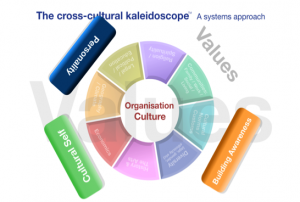
But this may manifest itself in unexpected ways. The leader of a person who has lived with political oppression such as slavery for example, is perhaps unlikely to realise how that could affect their attitude to work. They could perhaps be conformant or militant. Or they could pay lip service to the organisation culture whilst taking steps to sabotage it outside of work. Nevertheless, organisation culture is often the strongest factor in an Executive Coaching context. For this reason, organisation culture was placed right in the centre of the Cross-kaleidoscope model; in its full dynamic state (see figure 2).
Of particular relevance to coaching is not only do we have little awareness about the internationalisation of culture; of how it affects our perceptions and influences our decisions, but aspects from association with our past cultural groups may impact us now in the present. But again, we are often unaware of this. According to Hall (1994) values act as a “brokerage unit” or “peacemaker” and carry the energy of the inner world into the external world, as represented in figure 2. Thus, the internal and external worlds become inter-weaved with values creating the sense-making.
According to Carter (2008, p.99), “people brought up in diverse cultures often have a different personality in each one.” As a ‘cultural chameleon’ they are required to adapt in many diverse situations, environments and cultures. Cultural chameleons or global nomads may therefore lose sight of who they really are. Their core values may have become eroded or perhaps even more typically, start to conflict. These people may be presenting for coaching with values that no longer work well for them. They may for example struggle with the need to deliver short-term business results, at the expense of a personal belief system that values long term relationship-building in business. Conversely, they may have become so ‘Westernised’ in management approach that they strive to deliver results at the expense of meeting the needs of the team or the long-term future of the organisation or of society.
Research excerpt:
“He was required to be very gung-ho and talk about results, results, results at work, with his (British) friends he had to be this fun guy and at home he had to be respectful to his language and traditions. It got confusing for both of us”
French coach coaching a British-born Indian in UK
As mentioned, it is important to note that the Kaleidoscope model is not ‘leading with culture’. If there are no cultural issues manifesting in the coaching issue then it is clearly inappropriate to go searching for them. Furthermore, internal and external categorisations are not intended to ‘pigeon-hole’ or stereotype. The Kaleidoscope model – by its very nature – is intended to illuminate the complexity of the cross-cultural landscape. Where, thanks to creolised societies (Hannerz, 1992), migration and globalisation; boundaries are blurred and a person is a complex mix of influences. As illustrated in figure 3.
As migration persists and globalisation intensifies, more and more people are likely to present for coaching with complex cultural profiles, derived from exposure to multiple cultural influences. The skill of the cross-cultural coach is likely to lie in helping the coachee to identify which meanings they have attached to – and their consequent behaviours – that no longer work for them, given a change of context. This will invariably involve an element of ‘unlearning’; which is surely likely to be a key skill for the 21st century coach.
Applications to Coaching Practice
The following explains the different ways in which The Kaleidoscope model has been used for raising awareness:
- As a visual image for the coach to keep in mind either before or during the coaching and mentoring relationship in order to alert one’s ‘antenna’ to possible cultural issues (or the cultural impact upon the issue)
- To discuss with the coachee or mentee and use as a basis for exploration either before or during the coaching relationship
- To identify which of the segments or lenses of the Kaleidoscope holds the most resonance for the coachee and which may represent a good starting point for the coaching conversation
- To identify the ‘cultural self’/selves – working at the level of cultural identity
- To identify the impact of external influences upon leadership styles
- To identify cultural imperatives and conflicting internal values
- To raise the coach’s own cultural awareness to his/her own cultural bias
- To be presented as a global ‘wheel of life’ tool – i.e. on a scale of 1-10 how would you rank the importance of each of these influences in your life?
The following explains the ways in which the Kaleidoscope model has been used for taking responsibility:
- To create culturally-appropriate choice and behavioural change. This approach accommodates those coachees that are constrained by cultural mandates, such as a lack of assertiveness in deferent societies or strongly-held religious mandates.
- To ‘unlearn’ those cultural values that no longer work for the coachee. This approach accommodates exposure to different value systems, organisation structures and societies during the course of the coachee’s life span along with potential for internal conflict based upon conflicting and even competing values.
The Kaleidoscope as a team tool
Since its original inception, the Kaleidoscope has been identified as a tool for use with multi-cultural teams. Feedback from the coach practitioners suggests it has value in the following ways:
- The Kaleidoscope as a team-building tool: Here team members are typically seeking to understand each other or to share knowledge and can use each lens as a starting point to share information with their team mates
- The Kaleidoscope as a problem-solving tool: Here team members are typically engaged in solving business or technical issues and are ‘solutioneering’; i.e. innovating new products, solutions or services or new ways of doing things. By exploring some or all of the lenses they can identify where the blockages or problems lie.
- The Kaleidoscope as a transformational tool: Used in combination with a positive enquiry approach to coaching and a storytelling approach to leadership, the Kaleidoscope can be used as a transformational tool.
The reflective feedback received from the coaches using this model further suggested it has enormous potential to both deepen the relationship between the coach and the coachee. This finding was of key significance, given that the original research question was, “How important is it for the coach to have an understanding of a coachee from a different worldview.”
Research excerpt:
“I thought I knew my coachee. She went to university in the UK so I thought I understood her socialisation into this country. However, as we worked through the Kaleidoscope I realised how much I didn’t know about her and it deepened our relationship enormously.”
British Coach mentoring a coachee from Lebanon
The above quotation also points to the dangers when working interculturally of making assumptions. And, as suggested in the following research quotation it is important to reveal a lack of cultural understanding to the coachee, rather than to assume. Making assumptions, it was thought by the research participants, was possibly the biggest mistake to make in Cross-Cultural Coaching.
Research excerpt:
“I would be the first person to acknowledge if I didn’t understand what I thought was imbued in the culture.”
South African Coach working in the UK
Conclusion
It is suggested that a key competency for the Global Executive Coach or Cross-Cultural Coach is to work with raising culturally-appropriate awareness and to build culturally-derived responsibility, building on the definition of the essence of good coaching practice (Whitmore, 2002).
As globalisation persists, more people will potentially be exposed to different lifestyles, thought patterns, emotional expressions and behaviour during the course of the lifespan. ‘Global nomads’ or perpetual expatriates have experienced wide and varied influences from multiple cultures; often from childhood.
Coaches who are working with the manifestation of cultural behaviour, habits and norms, are best to keep themselves informed by cultural theory. Multiple branches of psychology have influenced studies of culture, particularly cross-cultural psychology, cultural psychology, social psychology and more recently, positive psychology. These divergent approaches have led to differences over whether culture restricts or enables cognitions and behaviours and as to whether a universal psychology should exist, despite evidence to suggest that there are differences in cognition patterns (Nisbett, 2005) between East and West. However, an overemphasis on cultural theory, particularly dimensions, can lead to sophisticated stereotyping and an ‘either/or’ perspective, which is not useful in an engagement seeking to leverage strength in diversity that may be derived from a ‘both/and’ paradigm.
When coaching global leaders, it is incumbent upon the Global Executive Coach to explore the complexity in which the leader operates. The executive is often leading at the “edge of chaos” (Lewin, 1993) from within a complex adaptive system (CAS). This means that coaching solutions become emergent and consequently, the coach needs to be comfortable working with paradoxical situations.
A systems approach to coaching reflects this complexity and also provides for the accommodation of otherwise competing or contradictory perspectives. It also means that the Western tools and models that focus on individual goals and outcomes are provided for, but are not at the expense of other cultural values that place an emphasis on the needs of the collective, such as relationships and harmony. Values and value systems are considered to be a good place to start in an intercultural coaching engagement.
It is important to realise that an intercultural approach is not leading with culture. There may be no cultural influences that have a bearing on the coaching relationship or context. However, the skill of the coach is required to illuminate any cultural differences that may be residing in the issue, such as communication styles for example.
The Cross-Cultural Kaleidoscope™ is a coaching tool that has emerged from a robust theoretical foundation that has explored the impact of culture from multiple perspectives. All too often, it is easy to make judgments based upon what is perceived to be manifest. Underlying the manifestations is a rich tapestry of deeply held cultural values and beliefs that drive behaviour. Some of this behaviour may be wired in the past and no longer serve the coachee and may well be acting against them in their current position or situation. Thus helping the coachee to ‘unlearn’ and to take culturally-appropriate responsibility can assist with change.
The reflective feedback received from the coaches using the Kaleidoscope model suggests that the model has value as an awareness-building tool. It has been used as a basis for discussion throughout the coaching session, thus shaping the entire coaching conversation. It has been identified for use either at the beginning, middle or end of a session or as a pre-session tool. It has been reported to have deepened the strength of the relationship, due to the potentially emotional nature of the enquiry it can evoke. Of key significance, given that the original research question was, “How important is it for the coach to have an understanding of a coachee from a different worldview”, is that it has been reported to have delivered to the coach a much greater depth of understanding of the coachee. However, this is based on a relatively small sample and further research is required to establish the value delivered to the coachee and to teams of multi-cultural workers.
It has been used as a tool to raise the self-awareness of the coach to his/her own cultural influences. In so doing the Global Executive or Cross-Cultural Coach needs to be mindful to bracket any knowledge or preconceptions before entering the coaching relationship and to hold any opposing cultural values “lightly”.
Tools such as the Kaleidoscope for teams, action learning, storytelling and an appreciate enquiry approach to coaching can help to elicit the meaning and purpose of multiple teams and to embed transformational change at a systemic level. As organisations strive to drive their function as social enterprises and to redefine themselves for this era of globalisation they will require solutions that can address paradoxical situations such as simultaneously competing and collaborating. As a result, it is likely that organisations will want to work with coaches that can co-create coaching solutions in the face of such complexity.
REFERENCES
Association for Coaching and Passmore, J. (Ed.), (2009), Diversity in Coaching, Working with gender, culture, race and age, London: Kogan Page Ltd.
Augsberger, D.W. (1986), Pastoral Counseling Across Cultures, Westminster: John Knox Press.
Bond, M. H. (1983), How language variation affects inter-cultural differentiation of values by Hong Kong bilinguals, Journal of Language and Social Psychology, 2(1), 57-67.
Bond, M.H. et al. (2004), Culture-Level Dimensions of Social Axioms and Their Correlates across 41 countries, Journal of cross-cultural psychology, 35;548-570.
Carter, R. (2008), Multiplicity, The New Science of Personality, London: Little, Brown Group.
Cavanagh, M. (2006), ‘Coaching from a systemic perspective, A complex Adaptive Conversation’, in: D.R. Stober and A.M. Grant (eds.) Evidence Based Coaching Handbook, New Jersey: John Wiley and Sons.
Drucker, P. (1954), The practice of management, Oxford: Heinemann
Ellis, A. and Harper, R. (1997), A guide to Rational Living, Chatsworth: Wilshire Book Company.
Fisher, G. (1998), Mindsets, The role of culture and perception in International Relations, 2nd edition, Clerkenwell: Nicholas Brealey Publishing.
Gannon, M. (2001), Cultural Metaphor, Readings, Research Translations, and Commentary, Thousand Oaks: Sage Publications, Inc.
Gilbert, K. and Rosinski, P. (2008), ‘Accessing cultural orientations: the online Cultural Orientations Framework Assessment as a tool for coaching’, Coaching: An International Journal of Theory, Research and Practice, Vol 1, No. 1, pp. 81-92.
Hall, B.P. (1994), Values Shift, A guide to personal and organisational transformation, Eugene: Wipf and Stock Publishers.
Hall, T.E. (1959), The Silent Language, New York: Anchor Books.
Hannerz, U. (1992), Cultural Complexity: Studies in the Cultural Organisation of Meaning, New York: Columbia University Press.
Hofstede, G. (2001), Culture’s Consequences, Comparing Values, Behaviors, Institutions, and Organizations across Nations, California: Sage Publications.
Hofstede, G. (2003), Cultures and Organizations, Intercultural Cooperation and Its Importance for Survival, London: Profile Books Ltd.
Hofstede, G. (2006), ‘What did GLOBE really measure? Researchers’ minds versus respondents’ minds’, Journal of International Business Studies, 37, 882-896.
Hofstede, G., Hofstede, G.J. and Minkov, M (2010), Cultures and organizations, Software of the mind, USA: McGraw Hill
Holland, J. (2006), Studying complex adaptive systems, Journal of Systems Science and Complexity, 19, pp. 1-8
House, R.J., Javidan, M., Hanges, P. Dorfman, P. (2002), Understanding cultures and implicit leadership theories across the globe: an introduction to project GLOBE, Journal of World Business 37, 3-10, Elsevier Science Inc.
House, R.J., Hanges, P.J., Javidan, M., Dorfman, P.W. and Gupta, V. (2004). Culture, Leadership and Organisations: The GLOBE Study of 62 Societies, Thousand Oaks: Sage Publications Inc.
IATA, 2012 https://globalnation.inquirer.net/58989/air-passengers-to-rise-28-to-hit-3-6-billion-in-2016-iata
Inglehart, R., Basanez, M. and Moreno, A. (1998), Human Values and Beliefs: A cross-cultural sourcebook, Ann- Arbor: University of Michigan Press.
Inkeles, A. and Levinson, D.J. (1963), ‘The Personal System and the Sociocultural System in Large-scale Organizations’, Sociometry, Vol.26, No.2, pp.217-229. (Original work published in 1954).
Kluckhohn, F. and Strodtbeck, F. (1961), Variations in Value Orientations, Evanston:Row, Peterson and Company.
Law, H., Ireland, S. and Hussain, Z. (2007), The Psychology of Coaching, Mentoring and Learning, Chichester: John Wiley & Sons Ltd.
Law, H.C. (2011) Intercultural coaching approach for Asian family business. In M. Shams & D. Lane (Ed.) Coaching in the family owned business – a path to growth. 41-58 London: Karnac Books.
Lewin, R. (1992), Complexity: Life at the Edge of Chaos, New York: Macmillan Publishing Company.
Lopez, S.J., Prosser, E.C., Edwards, L.M., Magyar-Moe, J.L., Neufeld, J.E. and Rasmussen, H.N. (2002), ‘Putting Positive Psychology in a Multicultural Context’, in: C.R. Snyder and S.J. Lopez (eds.), Handbook of Positive Psychology, New York: Oxford University Press Inc.
McClelland, D.C. (1985), Human Motivation, Glenview, IL: Scott, Foresman.
Moral, M. and Abbott, G. (Eds), (2009), The Routledge Companion to International Business Coaching, London: Routledge.
Moral, M. and Abbott, G. (Eds), (2009), The Routledge Companion to International Business Coaching, London: Routledge.
Moran, R.T., Harris, P.R. and Moran, S.V. (2007), Managing Cultural Differences, Global Leadership Strategies for the 21st Century, Oxford: Elsevier Inc.
Nisbett, R.E. (2005), The Geography of Thought, How Asians and Westerners Think Differently and Why, London: Nicholas Brealey Publishing.
Osland, J.S., Bird, A., Delano, J., and Jacob, M. (2000), Beyond sophisticated stereotyping: Cultural sensemaking in context, Academy of Management Executive, Vol 14, No.1
Plaister-Ten, J. (2009), International Journal of Evidence Based Coaching and Mentoring, Towards Greater Cultural Understanding in Coaching, Special Issue No.3, November 2009, Page 64
Plaister-Ten, J. (2010), Adapt and Survive, Coaching at Work, Vol 5, Issue 5
PriceWaterHouseCoopers (2010), Managing people in a changing world, Key trends in human capital a global perspective. https://www.pwc.com/gx/en/hr-management-services/pdf/managing-people-in-a-changing-world.pdf last accessed 11/2/13
Putnam, R.D. (1993), Making democracy work, Princeton, NJ: Princeton University Press
Rogers, C.R. (1964), ‘Toward a Modern Approach to Values: The Valuing Process in the Mature Person’, Journal of Abnormal and Social Psychology, Vol. 68, No.2, pp. 160 – 167.
Rokeach, M. (1973), The Nature of Human Values, New York: The Free Press.
Rosinski, P. (2003), Coaching across cultures, London: Nicholas Brealey Publishing.
Schein, E.H. (1992), Organizational Culture and Leadership, 2nd edition, San Francisco: John Wiley & Sons, Inc.
Schwartz, S.H. and Sagiv, L. (1995), ‘Identifying culture-specifics in the content and structure of values’, Journal of Cross-Cultural Psychology, Vol 26, No.1, pp 92 – 116.
Shams, M. and Lane, D.A. (2011), (Eds.) Coaching In The Family Owned Business; A path To Growth, London: Karnac Books
Stout-Rostron, S. (2009), Business Coaching International: Transforming Individuals and Organizations, London: Karnac Books
Tajfel, H. and Turner, J.C. (2004), ‘An Integrative Theory of Intergroup Conflict,’ in: M.J. Hatch and M. Schultz, (eds.), Organizational Identity, Oxford: Oxford University Press.
Triandis, H.C. (2001), ‘Individualism and Collectivism, Past, Present and Future’, in: D. Matsumoto (ed.) The Handbook of Culture and Psychology, New York: Oxford University Press.
Trilling, L. (1955), The Opposing Self, London: Secker and Warburg.
Trompenaars, F. and Hampden-Turner, C. (1997), Riding The Waves of Culture, Understanding Cultural Diversity in Business, London: Nicholas Brealey Publishing.
The United Nations Population Fund (2011), The State of the World’s Population 2011 https://foweb.unfpa.org/SWP2011/reports/EN-SWOP2011-FINAL.pdf
Van de Vijver, F. J.R., Van Hemert, D. A., Poortinga, Y. H. (2008), Multilevel Analysis of Individuals and Cultures, New York: Taylor and Francis Group
Vygotsky, L.S. (1962), in: John-Steiner, V., Souberman, E., Cole, M. and Scribner, S. (eds.) Mind in Society, The Development of Higher Psychological Processes, Cambridge: Harvard University Press.
Whitmore, J. (2002), Coaching for Performance, GROWing People, Performance and Purpose, 3rd ed., London: Nicholas Brealey Publishing.
© David Clutterbuck