
Readiness for change: The comfort-curiosity matrix
It’s common for coaches and mentors to feel frustrated that it is obvious what the client needs to do, yet somehow the client can’t move from awareness to action. Of course, everyone has occasions when they know they should take action, but can’t find the energy to do so. But how do we help shift happen?
The comfort-curiosity matrix is a tool developed by CCMI to help understand what is holding someone back – and therefore what help they may need.
Comfort refers to presence or absence of pain. High comfort predisposes us to inaction; high discomfort predisposes us to action. High curiosity is about being open to the possibilities of a new state and motivated to explore it. Low curiosity leads us to shut out disruptive thoughts.
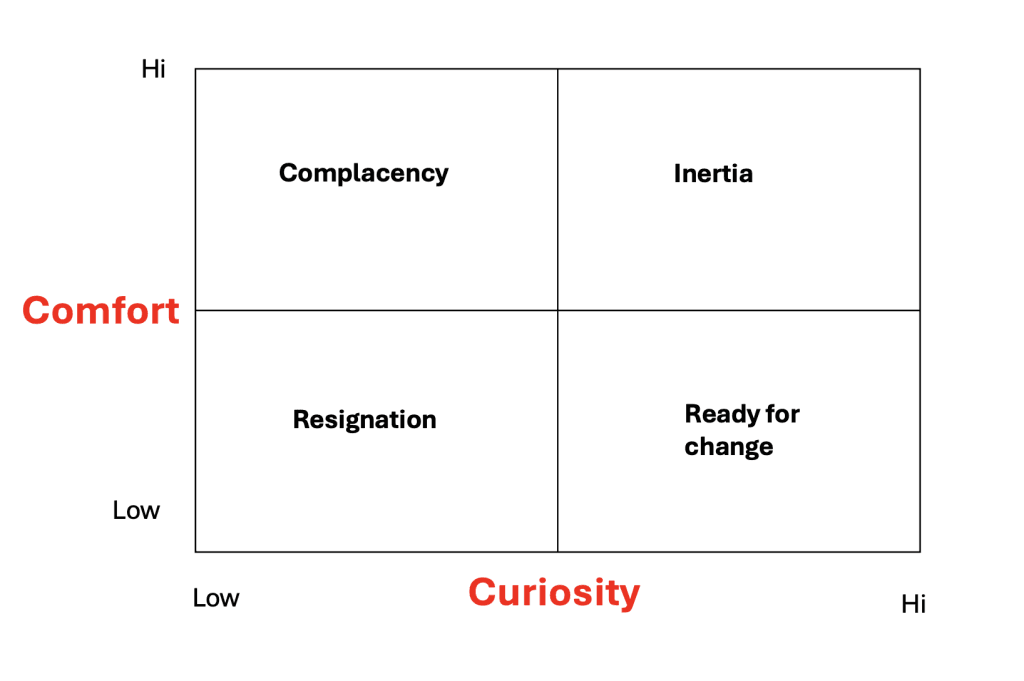
When someone has low comfort and low curiosity, they feel unhappy with the status quo, yet powerless to change it. They may also fear that any change would make things worse. This state we refer to as resignation.
When someone is happy with the status quo and fears that change may disrupt it, they are in a state of complacency.
For someone high in both curiosity and comfort, the idea of change is attractive, but either the motivation to make it happen is low (not enough gain for the pain) or they cannot see a clear path forwards. They are in a state of inertia.
Low comfort and high curiosity create a desire to change the status quo and openness to experiment. People in the ready for change quadrant are energised by the potential to progress and eager to create the space for new challenges.
Where we are on the matrix can fluctuate as circumstances change. My motivation to learn to lip read will be influenced by increasing frustration with missing conversations and by the volume of other pressing learning goals I have at the time. Recognising which quadrant we are in, however, allows us to create rational plans that take emotional drag into account.
© David Clutterbuck, 2026
Related Content
-
It’s National Mentoring Day again
27th October 2026 I’m pleased to announce that I h...
-
How to get the best out of your training and development budget.
“Training and development is like advertising. Nob...
-
Whatever happened to compassion, courage, curiosity and connection?
Several years ago, I trawled through a great mass ...
-
The role of AI in ethical coaching and mentoring
A recent paper in Philosophy Now explores the issu...
-
Mentor-coach or supervisor?
There has been a lot of confusion over the years.....
-
The other side of unconditional positive regard
Coaches can support executives in recognising what...
-
There is no such thing as neurotypical
Here’s yet another new word – Phantomolog – ...
-
A simple tool for emotional reflection
It’s good practice for coaches and mentors to spen...
-
How to overcome executive stress – the secret lies in reconnection
Coaches can support executives in recognising what...
-
Professional coach or professional mentor?
The work of the Coach Maturity Research Group demo...
-
The addictive power of AI
One of the results of this is that the more we use...
-
The perils of the passive coachee
The word spiritual keeps cropping up in relational...
-
Supporting well-being: The importance of rest
The word spiritual keeps cropping up in relational...
-
What does it mean to be spiritual?
The word spiritual keeps cropping up in relational...
-
Corporate B.S versus critical thinking
B.S receptivity refers to a person's tendency to e...
-
Two new books to stimulate innovative thinking
I make it a rule to challenge at least one deeply ...
-
Should a toxic work environment be classified as a breach of industrial safety requirements?
If an employer fails to ensure a workplace or work...
-
The subtle art of miscommunication
I was recently introduced to the work of Finnish r...
-
Coaching versus mentoring: an outcomes perspective
Clarifying the differences between coaching and me...
-
Climate Coaching Action Day – March 5th
What can you, as a coach, do for the planet......
-
Changing the debate on neurodivergence
I was pointed to a fascinating book at an EMCC web...
-
Challenging times for Human Resources
I was pointed to a fascinating book at an EMCC web...
-
We’re all neurodiverse
I was pointed to a fascinating book at an EMCC web...
-
Is AI creating two-tier coaching?
Coach-bots are becoming more and more sophisticate...
-
12 habits of a Toxic Mentor
The following are all examples of behaviours by me...
-
The most common mistakes in mentoring programmes
Over four decades, I have encountered thousands of...
-
Why mentoring and coaching programmes need a dedicated manager
Creating a coaching and mentoring culture isn’t ea...
-
How to help someone reflect on their future career: using the Ikegai questions
The Japanese concept of Ikegai is based around fou...
-
What did you learn about yourself this week?
Building the habit of reflection isn’t easy. Yet,...
-
What do executives think are the benefits of team coaching?
Manfred Kets de Vries, at INSEAD, the French busin...
-
The dangers of relying on an AI to write an article
AIs like Gemini or ChatGPT can be very helpful in ...
-
Psychedelic coaching
Board directors have immense responsibility – the ...
-
Tomorrow’s Board: Why every director needs the skills of coaching and mentoring
Board directors have immense responsibility – the ...
-
How to make new habits stick
“Stacking” is a term that refers to linking a habi...
-
A simple approach to ethical dilemmas
The Defiance Compass poses three powerful question...
-
What does it mean to be present as a coach or mentor?
Presence is one of those words that gets used and ...
-
Enter the Otrovert
I once went through a battery of psychometric test...
-
The protégé effect: How mentors learn from mentoring
The protégé effect: How mentors learn from mentori...
-
An executive’s last 24 months in role before retirement – how to maximise the transfer of wisdom
Whenever a valued executive retires after many yea...
-
Core Qualities
Daniel Ofman’s Core Qualities model seeks to expla...
-
Feedback loops in Team systems
Feedback loops are an intrinsic part of all but th...
-
Future Story
Both individuals and teams often find it hard to f...
-
What makes a cost-effective coaching and mentoring strategy?
While most large employers at least pay lip servic...
-
Helping the team gain a more strategic perspective
Strategic thinking is both an art and a skill. It ...
-
AI versus human: the issue of memory
Yet another perspective on the differences between...
-
Could your next career be Professional Mentor?
As executives in organisations come up to retireme...
-
Beyond Team Coaching: Staying ahead of the game
Burnout is a phenomenon we usually associate with ...
-
What’s the point of mentor accreditation?
Burnout is a phenomenon we usually associate with ...
-
Why mature coaches are increasingly moving towards being professional mentors
Burnout is a phenomenon we usually associate with ...
-
Making change happen
This simple formula helps someone plan how to brin...
-
The leader as lonely dragon: a parable of imposter syndrome
Once there was a dragon king, who lived in a......
-
What makes genius teams tick?
Every now and then, we meet teams that are extraor...
-
The expectation exchange
Friction within teams or between individuals often...
-
Four keys to better conversations online
A useful summary of research into successful onlin...
-
Tangles – a new metaphor for coaching harmonics
Whether it be a computer cable, a garden hose or.....
-
Who is in control of how you spend your time?
One of the key aspects of a sense of work-life......
-
Working with highly sensitive people
The more we understand and appreciate the value of...
-
The Power of Emotionally Intelligent Presence
How the Way You ‘Show Up’ Shape Your Influence and...
-
Another step into unreality
One of the anchors of people’s sense of security i...
-
ICF? EMCC? What’s the difference?
Once upon a time (not so long ago, really) there.....
-
PERILL Team Diagnostic
Just Launched - Visit the PERILL Website Prof Davi...
-
Coaching Executives (article by Craig McKenzie)
Coaching executives is a large part of the Transce...
-
If it’s worth doing, it’s worth doing differently
Today is Opposite Day (25th January, 2024) The boo...
-
Could AI replace the Board?
A couple of decades ago, when I was advising the.....
-
Belonginess surveys – how to get under the surface of people’s lived experience at work
When someone feels they belong in an environment, ...
-
Stages of team development
A frequent comment from coaches on our team coachi...
-
Choosing a team coaching co-coach
While it’s not essential always essential to have ...
-
Pain in the system
Whether working with an individual or a team, coac...
-
Learning from the learning disadvantaged
When I reflect on what I am grateful for, high......
-
Tied up in knots? Does knitting therapy bind the coach-client relationship?
When I first heard of coaching sessions, where bot...
-
The Seven Layers of Mentoring
Dialogue in mentoring, and in related disciplines ...
-
The disconnected executive
Somewhere in my files is a note on a piece......
-
Introducing the Workaholiday
Creating a personal balance between the work-relat...
-
Supervision as coach pair
Two coaches working together with a client team ne...
-
Grow up? I think I’ll pass
It’s said that “growing old is compulsory; growing...
-
How much of what you do each day at work is truly useful?
It’s one of those showstopper questions that peopl...
-
How to cultivate “belongingness” in teams
When someone feels they belong in an environment, ...
-
Where does happiness sit on the coaching client’s agenda?
The remarkable thing about coaching clients puttin...
-
Three levels of purpose
One of the reasons teams struggle to define their ...
-
How much quality time does your team spend together?
When domestic couples are too busy to spend qualit...
-
What’s in a gesture?
Cultures differ in how much people instinctively g...
-
Why every leader needs their own manifesto
What do you stand for? If you were asked this......
-
Starting to create psychological safety
One of the everyday challenges for team coaches is...
-
Educating the Board: A key role for HR
A recent study by PWC and The Conference Board rev...
-
How coaching and mentoring are evolving in China and India
After several years absence from Hong Kong in the ...
-
Would you choose YOU as your best friend?
As a question to stimulate reflection, this can be...
-
Mentorship in finance: A great leveller?
Well-designed and managed mentoring initiatives ca...
-
Another strong reason for rooting out toxic bosses
The immediate impact of toxic bosses on their team...
-
Why the great resignation is a good thing
Across America last year almost 20 million people ...
-
Traditional, reverse and reciprocal mentoring – a continuing evolution
Formal mentoring programmes have been around since...
-
How fast is coaching changing?
There’s no doubt that the world of coaching is cha...
-
How to help clients reset and recover
Studies from the University of Groningen in the Ne...
-
Coach development plan – a key to continuous Professional Development
Professional coaches and mentors are in the busine...
-
Trust recovery in the team
Once trust is broken in a team, it is hard......
-
The integration of AI and coaching: A vision of a not-so-distant future
The executive knows she has a tough week ahead,....
-
Diversity and Inclusion: Or Dithering and Indecision?
When historians look back at how companies and soc...
-
How to take collective responsibility for individual development
Personal development plans are a great idea in t...
-
The value of ad-hoc, unexpected learning conversations
One of my fondest memories of my late colleague Da...
-
How to coach a client with a closed mind…
Most people have some strong opinions, but these d...
-
The impact of peer mentoring on wellbeing
A recent study* of 150 female university students ...
-
How to help a team cope with chaos
Many teams and organizations operate on the bounda...
-
What’s the right level of discomfort?
Human beings initiate change when they feel discom...
-
What to do when a coaching client has strong beliefs that limit their thinking
Everyone has some beliefs that they hold onto, eve...
-
Making co-coaching a normal team behaviour
One of the signs of a coaching culture in a......
-
Second wave coaching and mentoring
Second wave coaching and mentoring In the recent y...
-
Group mentoring
Group mentoring is a relatively recent innovation....
-
How to be a mentor to mentors
One of the key supports for mentoring programmes i...
-
New Year’s resolutions for mentoring program managers
As the world struggles with recession and uncertai...
-
Keep your Mentoring Programme fresh and vibrant!
The Mentoring Expert Webinars with David Clut...
-
Managing the three way contract in executive coaching and mentoring
Arguably the most common cause of problems coaches...
-
Guidelines for virtual group supervision
In coming to virtual group supervision, people ten...
-
Why outdoor coaching and mentoring work better than indoor
The virtues of being in an outdoor environment for...
-
When leaders learn to shut up
Here is a powerful but deceptively simple exercise...
-
I could do with a laugh right now….
One of the characteristics of great coaches and gr...
-
Take care of your mistakeholders
No, it’s not a typographical error – it’s the late...
-
Change in teams isn’t always obvious
It’s a truism that change is often more noticeable...
-
Team coaching isn’t just for coaches
The expansion of team coaching as a profession has...
-
The in-between conversation – making the transition between coaching the individual leader and coaching their team
A high proportion of team coaching assignments ari...
-
A true story about experts and statistics
Some 30 years ago as a young management write...
-
What every HR director should know about coaching and mentoring strategy
Although overall spend on training and development...
-
Does your client want to be different or normal?
“Which is more important to you in building and ma...
-
The three-way conversation in coaching and mentoring
The three-way conversation between coach, client a...
-
From coach to professional mentor
Why would successful coaches want to join the grow...
-
Why mentors need supervision
All the coaching professional bodies in Europe and...
-
Mentoring disadvantaged young people
Mentoring for disadvantaged young people can be di...
-
Contextual intelligence in mentoring
Two articles in the latest issue of Harvard Busine...
-
Are you getting value for money on your investment in mentoring?
You’d expect most companies with established mento...
-
Line manager, mentor and coach: managing the conflicts and capitalizing on the opportunities
As a line manager, one of your principal responsib...
-
Why naming an emotion helps manage it
Recent research at the University of North Carolin...
-
Wisdom and mentoring
Development mentoring’s focus on the acquisition o...
-
Helping the coachee or mentee overcome complacency
An implicit assumption within coaching and mentori...
-
Mentoring in acquisitions and mergers
Some years ago, a company, which I was chairman of...
-
Creating your Personal Development Plan as a Coach or Mentor
As coaches and mentors, we expect our clients to h...
-
What do we mean by confidentiality in mentoring?
When people glibly say that the mentoring relation...
-
Coaches and mentors bearing gifts
Studies have shown that overly altruistic motivati...
-
Skills of a multicultural mentor
Studies by two professors at French business schoo...
-
Team coaching: What’s the point?
Coaching one-to-one is a very powerful way to help...
-
Where next with research in mentoring?
It would be easy to conclude, from the vast number...
-
The problem with research in mentoring
One of the remarkable aspects of mentoring is how ...
-
Step forward the ethical mentor
Ethical mentoring is a fairly new term, but it’s l...
-
What do we mean by success?
One of the exercises I frequently conduct with aud...
-
The role of wisdom in the coach/mentor – AI partnership
In all the major models of human maturity, two qua...
-
Coaching and mentoring as conversations about context
If coaches and mentors rarely, if ever, offer advi...
-
The pivotal role of mentoring and coaching in health services
The health sector has a long history of involvemen...
-
Coaching and mentoring people on the autistic spectrum
Autism is a badly misunderstood condition. While e...
-
Mentoring and coaching CEOs
A recent article in Harvard Business Review propos...
-
Making reverse mentoring work
Practical guidelines for programmes Reverse mentor...
-
What to do when the mentee has no clear career goals?
It makes mentoring a lot easier, when the mentee k...
-
Does fear of opening up something you can’t handle hold you back from asking tough questions?
Even very experienced coaches and mentors admit to...
-
Helping a coachee or mentee manage uncertainty
Much as humans generally crave certainty, we have ...
-
When the coachee or mentee is unhappy with their current job
Everyone has times, when their job just doesn’t se...
-
What if the client worries too much?
Like most human traits, worrying in the normal cou...
-
12 habits of a Toxic Mentee
The following are all examples of behaviours by me...
-
A bundle of MDQs
Massively Difficult Questions (or MDQ's for short....
-
Cross-organizational mentoring
There is only a relatively small number of mentori...
-
Disability mentoring
One of my most emotive recollections of mentoring ...
-
Evaluating Mentoring
One of the paradoxes of formal mentoring programme...
-
How can I change the behaviour of my mentor?
When mentoring relationships fail, one of the most...
-
How could you get more out of your mentoring relationship?
Like any other relationship, mentoring can get a b...
-
How mentoring supports inclusion
Inclusion: Genuinely valuing a wide range of diver...
-
How to make the most of the mentoring relationship
Mentoring relationships that deliver most value fo...
-
What makes a powerful question?
Powerful questions we can define as ones that have...
-
Why do we need to train mentees?
One of the most common reasons for mentoring progr...
-
Five modes of questioning
Asking questions is something we do all the time. ...
-
Helping the coachee/ mentee develop a wider community of support
One of the most common questions in coaching and m...
-
Helping the coachee or mentee pitch an original idea
A common misconception in organisations is that it...
-
Working with ethical dilemmas
Many of the issues that coaches and mentors encoun...
-
Why coaches and mentors shouldn’t beat themselves up when client change doesn’t happen
Every beginner coach or mentor goes through a phas...